Why Your Business is Invisible (And How to Fix That)
WRITTEN by: Bill Sterzenbach |
categories:
SEO


When we think of disruptive technologies, we naturally tend to think of one technology displacing another, whether it’s the railroads making canals obsolete in the 19th century or tablet computers making netbooks disappear in recent times. But what happens in the middle of that disruption period when a technology effectively eliminates an old one, but has not yet been fully adopted itself? In other words, what if the canals were filled in and abandoned before most people and businesses knew how, where or why to use the railroad?
I think exactly this kind of disruption is happening right now in the way consumers look for a local business. I’m talking about the significant decline in the old technology – the Yellow Pages – and the not-as-big rise of the new technology – online Local Search. This disruption has created a gulf between consumers and small businesses.
Whether you rely on statistics, anecdotal information or just common sense, it’s widely recognized that the Yellow Pages, a reliable and nearly impregnable business for nearly a century, has been irrevocably altered by the rise of online search. On the anecdotal level, you hear people joke about the Yellow Pages being useful mainly as a doorstop and you see cities such as San Francisco actually trying to ban their delivery, saying they waste trees and end up in landfills.
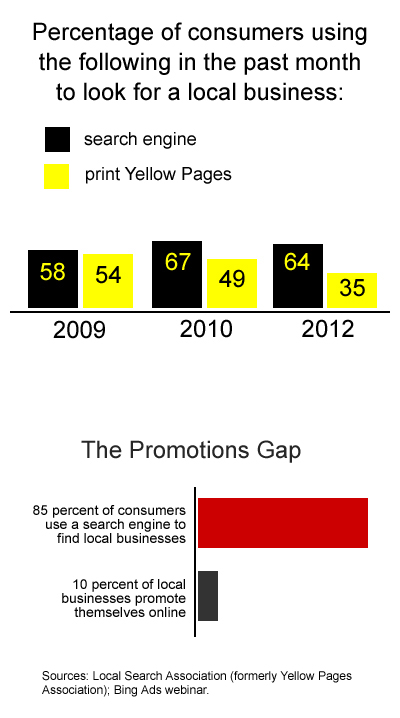
More specifically, we’ve also seen spin-offs, bankruptcy reorganizations and rebranding strategies as companies move beyond yellow paper to online directories. The industry association itself, formerly the Yellow Pages Association, even changed its name to the Local Search Association. As seen in the chart at right, statistics from the Local Search Association, which has every incentive to try to paint a rosy picture of Yellow Pages usage, show the steady decline in the use of printed directories.
So if fewer people are looking for a plumber or a tax accountant or a transmission repair shop by letting their fingers do the walking across yellow-tinted paper, then Local Search has filled the gap, right? Well, not really. Or at least not yet.
While 85 percent of consumers use the internet to find local business, less than 10 percent of small businesses promote themselves online, said Ginny Sandhu, Senior Product Marketing Manager for Bing Ads, in a recent webinar.
I tried an experiment myself to see if this phenomenon holds up right in my own back yard. I tried some searches to see if local businesses I knew existed would show up. While I was eventually able to find some of those businesses by using the maps option in Google, they did not appear in the results from the sort of more casual search a typical consumer might use.
There were a few reasons for that, including the fact that listings were not optimized or there weren’t enough listings in a given category to ”trigger” local listings. The end result is that most of these small businesses I knew existed in my area didn’t show up in the kind of search a typical consumer today would use. I suspect that most of those small and local businesses just don’t have the resources or expertise to optimize their listings and therefore their uncertainty about what to do easily translates into paralysis.
I think there’s also another influence that has to do with the difference between the nature of the old technology, the Yellow Pages, and the new, Local Search. In the past, a sales person from the Yellow Pages proactively approached local businesses, trying to sell advertisements. But even businesses that did not buy an ad still received a listing in the directory portion. Consumers could reasonably expect that practically every business in town would have at least its name, address and phone number in the Yellow Pages.
As my own little experiment above showed, we consumers can’t count on that today.
Consumers looking for local businesses today, using Local Search, won’t necessarily see the best, worst, biggest, smallest or most popular local businesses. They certainly won’t see all local businesses. What they will find is an abbreviated listing of the businesses that happen to have enough internet savvy to recognize the importance of showing up in Local Search and the ability to take a few steps to make sure they do.
This gulf between consumers looking for local services and local businesses wanting to be found is not good for either side.
If you’re a local business owner or manager who hasn’t taken the steps to ensure your business shows up in Local Search results, you are essentially invisible to most people using the most common way of looking for you.
So since I’m supposed to be the internet marketing expert, what do I suggest? Two things. First, I think every small business should set aside the amount they would spend for Yellow Pages marketing and budget that money for online marketing, especially making sure that your local listings online are accurate, consistent and up to date.
Second, I’ve got an offer for you, especially if you’re still feeling lost about how to start promoting your business online. We’re offering a way for you to get started with no cost and no obligation. Hop over to Facebook to “Like” our page, and leave your business name and contact email address in the comments. The first 10 to do so will receive one listing at their business location for one year, absolutely free. The canal is quickly filling with sludge, so let us help you hop on board the Local Search Express.


